
The Complete 2026 Productivity Tool-Kit with AI, Automate & Attention Hacks
Productivity toolkit 2026 combines AI, automation, and attention hacks to save you 20+ hours every week – without willpower.
You have tried to‑do lists. You have tried time blocking. You have worked the Pomodoro method. However, somehow you still arrive at the end of the week asking yourself — Where did it all go?
Any time a productivity system depends mainly on willpower, it is destined to fail. You forget to track time. You skip the morning routine. Entering Data Between Applications This means that you copy the data manually between applications.
The 2026 productivity system is another beast. It has AI, automation and focus tools, so the system just runs itself.
It synthesizes everything you need in a single guide:
-
AI Tools that Help me Save 10+ Hours/Week
-
Annoying tasks dead — no-code automation
-
With time trackers to uncover invisible leaks
-
Enter Pragma, with smarter meetings that halve call time.
Build this system once. Let it run forever.
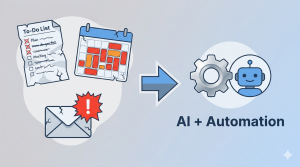
People don’t seem to understand how this new world works and why the productivity system they are forced to use is broken.
You probably use:
-
A to-do list (that makes it to lunch time before going ignored)
-
A calendar (that fills up with meetings you didn’t ask for)
-
Email (which really attacks your attention all day long)
These tools will not communicate with each other. And you become the glue – pushing data around, pursuing follow-ups, and rehashing in meetings.
The solution: Automation, not willpower. Focus on what matters, Let AI do the boring work
What the 2026 Productivity system looks like? The 4 Pillars.
| Pillar | What It Solves | Your Existing Article |
|---|---|---|
| 1. AI Productivity Tools | Routine Tasks, Email, Calendar Chaos | 5 AI Productivity Tools That Saved Me 10+ Hours |
| 2. No-Code Automation | Data entry, file renaming, app syncing | 7 No-Code Automation Tools for Annoying Tasks |
| 3. Time Tracking & Focus | Hiding time leaks, within focus | 6 AI Time Tracking Apps to Recover Lost Hours |
| 4. Smarter Meetings | Long calls without notes with lost action items | 5 AI Meeting Tools That Help You Save Half the Call Time |
(After publishing, replace # within internal links.)
Pillar 1: AI Productivity Tools
In the first article of this series, we used AI productivity tools that remove the three main time‑wasters:
Email Overload → Sanebox
Sanebox knows the kind of emails you read. Automatically sorts junk, newsletters and low-priority messages into folders. Your inbox is a line of actual projects.
Time saved: 5–10 hours/week.
Calendar Chaos → Reclaim.ai
Reclaim protects your deep work. 2 hours of focus in the mornings you just tell it. When a meeting comes up, Reclaim automatically reschedules your focus block.
Time saved: 2–3 hours/week.
Meeting Notes → Otter.ai
Otter lists for you to join your calls, transcribe and highlight action items. So say goodbye to the question, “who was meant to do that?”
Time saved: 1–2 hours saved per meeting
➡️ Read the Complete Guide → 5 AI Productivity Tools That Helped Me Save 10+ Hours Weekly
Pillar 2: No‑Code Automation
Time suckers like manual data entry and file organization go unnoticed. If you want to set it up without writing any code, you need a no‑code tool.
Zapier
When you have an email message that appears → save the attachment to Google Drive. Client submits a form → add them to your CRM. There are thousands of these being processed by Zapier.
Example: a real estate agent automated lead emails → CRM → follow‑up task. Saved 8 hours/week.
Make (formerly Integromat)
More powerful than Zapier when you needed complex logic. Example: Automated Client Onboarding by a freelancer: Typeform → Google Sheets → Gmail (welcome) → Asana (project). Saved 3 hours per client.
n8n
Open‑source and self‑hosted. Perfect for sensitive data. A Florida-based medical billing service has implemented n8n to seamlessly move claims between internal tools without ever accessing third-party clouds.
➡️ Read the complete guide here: 7 No-Code Automation Tools to Kill Your Most Annoying Tasks
Pillar 3: Time Tracking & Focus Hacks
Without measuring something you can’t fix it. AI time tracking runs quietly in the background.
RescueTime
Labels all apps and websites as productive or distracting. For instance, one software developer realised they spent 9 hours/week on Reddit and Twitter. He blocked those sites and got back 6 hours.
Timely
No start/stop buttons. Tracks the apps and documents you use, then automatically logs time to projects. A graphic designer discovered she was spending 12 hours a week sending emails – not designing. She doubled her billable hours and brought on a VA.
Clockify (Free)
An AI that offers up time entries based on your calendar — for free. An Oregon freelance writer quit under‑charging and added $500/month to her pocket.
➡️ Go to the complete guide: 6 AI Time Tracking Apps That Will Get Some Of Your Missing Hours Back
Pillar 4: Smarter meetings and teamwork
Remote workers’ top gripe: meetings. AI tools solve the three pain points:
Problem 1: No Notes → Otter.ai / Fathom
Live transcripts and action items. A Chicago agency cut post‑meeting recap time by 80%.
Problem 2: Information Lost → Fireflies.ai
Searchable meeting library. Ask: “What did we say about the Q3 budget?” and it finds the answer through hundreds of calls.
Problem 3: No Follow‑up → MeetGeek
Automatically pushes action items into Asana or Trello. A Denver nonprofit cut board meetings from 90 to 45 minutes.
👉 Read the complete blog: 5 AI Meeting Tools That Reduce Your Call Time by 50%
The 30-Day Implementation Plan for Your Productivity System
Week 1: Track & Measure
-
Install RescueTime (free) or Timely (free trial)
-
Run as is for 5 days without changing anything
-
Review your most recent report — discover 2–3 hidden time leaks
-
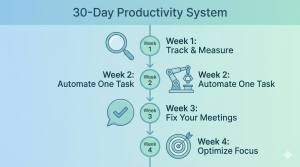
Follow this 30‑day plan – one small step each week. By day 30, your productivity system runs on autopilot.
Week 2: Automate One Annoying Task
-
Get rid of your most hated manual task (data entry, renaming files, sorting through emails)
-
With Zapier (free tier) or Make, create one automation
-
Test it with 3 real examples
Week 3: Fix Your Meetings
-
Add Otter.ai or Fathom (both free) to each meeting
-
Review action items as they come out of the call
-
Share summaries with your team
Week 4: Optimize Your Calendar & Focus
-
Set up Reclaim.ai (free plan for 1 habit)
-
Save 90 minutes of deep work every morning
-
Block time‑sucking sites with RescueTime focus session
Real USA Success Story: Full System Implementation
Jennifer, California – Operations Director at a 20‑person marketing agency
Jennifer inherited a mess:
-
25 hours of meetings per week
-
No centralized task tracking
-
Constant email fires
-
Lost action items everywhere
She implemented the 4‑pillar system within 8 weeks:

| Tool | Result |
|---|---|
| Sanebox + Reclaim | Email time: 3h → 1h/day; Focus gained: 2h/day |
| Make (Automation) | Automated client reporting: –15 hours/week |
| RescueTime | Distraction found – 8h/week – blocked social media |
| Fireflies + MeetGeek | Meetings: 25h → 12h/week; Action item completion: 50% → 90% |
Total time saved: 28 hours per week for her team.
Her words: “I would feel like I was drowning. Now the system runs itself. I literally walk out of the office at 5 PM.”
Tools Summary Table (Quick Reference)
| Pillar | Best Free Option | Best Paid Option | Time Saved |
|---|---|---|---|
| AI Productivity | Otter.ai (300 min/month) | Sanebox ($29/mo) | 10+ hrs/week |
| No‑Code Automation | Zapier (100 tasks/mo) | Make ($9/mo) | 5–15 hrs/week |
| Time Tracking | RescueTime (basic) | Timely ($16/mo) | 5–10 hrs/week |
| Meeting Tools | Fathom (free) | Fireflies ($19/mo) | 5+ hrs/week |
Final Words – Stop Depending on Willpower
The most productive people in 2026 are not trying harder. They build systems.
Select one of the pillars mentioned in this guide. Implement it this week. Next week, add another. In a month, you will have a system that allows you to be productive while sleeping.
Which pillar will you start with?
(Click on the links of the individual pillars and use one of its free tools today.)