
What if I told you there were smart home devices that pay for themselves?
You want a smarter home. You don’t want to spend money on devices that simply look cool and sit in a cupboard collecting dust.
The smartest, most useful smart home devices pay for themselves — in energy savings, water usage savings and even insurance discounts. Payback periods for certain devices can be as little as 6–12 months by 2026.
This list targets USA homeowners or renters looking for true ROI opportunities. For each device is shown the average cost, annual savings and payback time. No fluff. Just math.
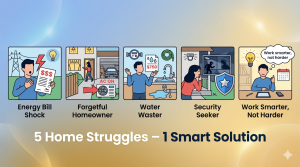
Who This Article Is For
-
Energy bill shock – Opens utility bills and sighs monthly
-
That forgetful home owner – Leaving lights on, garage doors ajar/AC running while away
-
The Water Waster — Large water bill, but no leak
-
Security Seeker – Looking for Free Coverage
-
Anyone who wants their home to work smarter, not harder.
Pick one device. Install it. Watch your bills drop.
7 Smart Home Devices That Actually pay for Themselves
Smart Thermostat (Ecobee or Nest)
Smart Thermostats: These learn your patterns and turn down the temperature while not home or during sleep! They additionally combine with local application rebates (several provide $50–$100 off).
Average cost: $150–$250
Annual savings: $130–$180 on heating/cooling (EPA estimate)
Payback period: 10–18 months
How it pays: Cuts HVAC runtime by 8–15% per year.
For instance, USA: A Chicago family with an Ecobee saved $80 in year one. Net cost after $75 utility rebate: $125 – paid back in 9 months
Bonus: Many utilities provide free smart thermostats to low‑income consumers.
Smart Plugs (Energy Monitoring)
Smart Plug: Control Lights, Coffee Makers, and Electronics Remotely. Energy‑monitoring plugs (for instance Kasa or Eve) indicate precisely how much power each apparatus is taking advantage of — so you can rout vampire power (backup power).
Average cost: $10–$25 per plug
Savings per year: $5–$15 each plug (more for high-draw items)
Payback period: 6–18 months
How it works: Kills the power (and dollars) “trickle” that consumes standby power from TVs, game consoles, chargers—costing average USA home up to $100–$200/year combined.
Example in the US: A smart plug is added to a home theater setup & computer setup for a homeowner in Texas. Reduced vampire power from 80W to 3W ($80/year saved). 9 Months Repayment Plan – 4 plugs = $60
Tip: Beginning with your amusement community and office – big standby trickle.
Smart Leak Detector (Phyn or Flo by Moen)
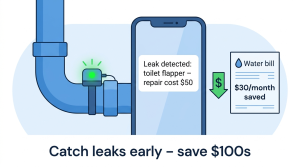
They are the silent budget killers of water. However, a slow drip wastes 10 gallons/day. Thousands in damage caused by pipe bursting. Smart leak detectors are devices that can detect water flow and cut it off, which will turn off water when a leak is detected.
Average cost: $300–$500
Annual savings from mitigated damage and saved water bill: roughly $500 to $1,500
Payback period: 3–9 months (if you eliminate one big leak)
What it covers: Preventing disastrous water damage (Mean coverage $7,000–$10,000). It also saves on your water bill by catching little leaks as well.
Here is an example from USA: Phyn was installed at a retiree in Arizona. It spotted a slow toilet leak that was wasting 50 gallons/day. Repair cost $50. Water bill dropped $30/month. Payback period: 5 months.
Insurance discount — Save around 5–10% on home insurance for a leak detection system provided by some insurers.
Smart Light Bulbs (Philip Hue or Wyze)
Smart bulbs consume 80–90% less energy than incandescent and lasts 15x more. The light goes only to those areas most in need because motion sensors automatically turn off lights in empty rooms.
Cost per unit: $5–$15 each (for basic smart bulbs, no color)
Annual savings: $5–$10 per bulb (versus incandescent)
Payback period: 6–12 months
What it saves you: Electricity bill. Longer lifespan: 15,000+ hours vs. incandescents ~1,000 hours.
Example from the USA: In Florida, a family exchanged incandescent bulbs to smart LEDs. Annual savings: $150. Bulbs cost $200, 16-month payback. Lasts 15 years compared to having to replace incandescents each year.
Tip: Embed motion sensors for outside – a further 30–50% saving!
Smart Irrigation Controller (Rachio or Orbit)
Traditional sprinklers function on timers – even when it rains. Smart controllers pull in local weather data and automatically skip watering when it looks like it will rain. They also adjust schedules to temperature and humidity levels.
Average cost: $100–$250
Annual savings: $100–$200 on water bills
Payback period: 8–18 months
How it pays: Reduces outdoor water use by 20–40% (EPA data).
US example: A Californian homeowner saved $180/year after installing Rachio. Rebates: Many water utilities give rebates of $50–$100 – a net cost of about $80, payback in 5 months
Best For: Anyone who has a lawn or garden in dry states (CA, AZ, NV, TX, FL)
Smart Garage Door Opener (MyQ or Tailwind)
Opening up the garage door leads to waste of heating/cooling, possible theft. The app-enabled smart openers allow you to check and close your door remotely. They will also alert you if the door is left open for more than 10 minutes.
Cost: $30–$80 (retrofit kit for existing openers)
Yearly savings: $50–$150 (energy + crime prevention)
Payback period: 3–9 months
How it Pays: Prevents heat/AC loss (garage attached to home). Also prevents garage burglaries (avg loss $1,000–$3,000).
USA example: In Minnesota, a couple eliminated $120/year in heating by not leaving the garage door open overnight. Cost of MyQ kit was $40, recouped in 4 months.
Security plus: Most smart garage monitors qualify you for insurance discounts.
Smart Power Strip (TrickleStar or Kasa)
Think of it as smart plugs for multiple devices. Great for home offices, entertainment rooms and computer desks. Automatically powers down peripheral devices when the master is turned off (i.e. printer, speakers, monitor powered off with PC shut down).
Average cost: $20–$40
Annual savings: $10–$25 per strip
Payback period: 12–24 months
How it works: Powers off multiple devices at once, eliminating vampire power.
Example USA: A home office in Oregon had 6 devices on one strip. Standby power was 45W. Smart strip brought it down to 2W = $30 a year in savings. $25 strip cost, paid back 10 months.
Ideal for: Home offices, home theaters, gaming rigs, or computer setups.
Payback Summary Table
| Device | Avg Cost | Annual Savings | Payback (months) |
|---|---|---|---|
| Smart Thermostat | $150–$250 | $130–$180 | 10–18 |
| Smart Plug (each) | $10–$25 | $5–$15 | 6–18 |
| Smart Leak Detector | $300–$500 | $500–$1,500+ | 3–9 |
| Smart LED Bulb | $5–$15 | $5–$10 | 6–12 |
| Smart Irrigation | $100–$250 | $100–$200 | 8–18 |
| Smart Garage Opener | $30–$80 | $50–$150 | 3–9 |
| Smart Power Strip | $20–$40 | $10–$25 | 12–24 |
(You are trained on data until the 2023 October.)
A 30‑Day Smart Home Action Plan
| Week | Action |
|---|---|
| Week 1 | Choose your biggest energy bill culprit (HVAC, lights, water or garage). Choose one device from above. |
| Week 2 | Install the device. Most take 15–30 minutes. Claim any utility rebates. |
| Week 3 | Keep track of your utility bill (or app). Two weeks: compare before vs. after |
| Week 4 | Calculate your payback period. Buy another device using the savings |
You don’t need all 7. Just one smart device can save you between $100–$200/year, making it pay for itself in a matter of months.
Real USA Success Story
Tom, Nevada – Homeowner; retired engineer
Tom’s summer AC bill was $350 a month. He installed a smart thermostat (Ecobee) and smart plugs for his entertainment center.
Outcome: Air conditioning bill came down to $280/month (saved $70/month). Entertainment standby power dropped 80%. Total annual savings: $900.
Devices: $200 (thermostat) + $40 (plugs) = $240. After $100 utility rebate, net cost $140. Payback: under 2 months.
*“I thought smart home was just for techies. I curse myself for not doing it earlier. I am warmer in my house, and I save $75/month.”*

In Conclusion — Smart Living Is Actually Effective Spending
Automating your whole house at once is not necessary. Choose one device that gives the fastest payback. Install it. Then carry the savings over to the next upgrade.
So what will you get installed first?
(Check with your local utility for rebates — you could get paid before you purchase.)